


Archive for December 07, 2025
Join me at Nerd Nite in NYC on December 13!
“When you're going through hell, keep going." This podcast is about failure and how it breeds success. Every week, we talk to remarkable people who have accomplished great things but have also faced failure along the way. By exploring their experiences, we can learn how to build, succeed, and stay humble. The podcast is hosted by author and former TechCrunch and New York Times journalist John Biggs. He also hosts The Innovators, a podcast focused on brand new startups and C-Level Executives and Creators. If you’d like to appear on either show, email john@biggs.cc. Our theme music is by Policy, AKA Mark Buchwald. (https://freemusicarchive.org/music/policy/)
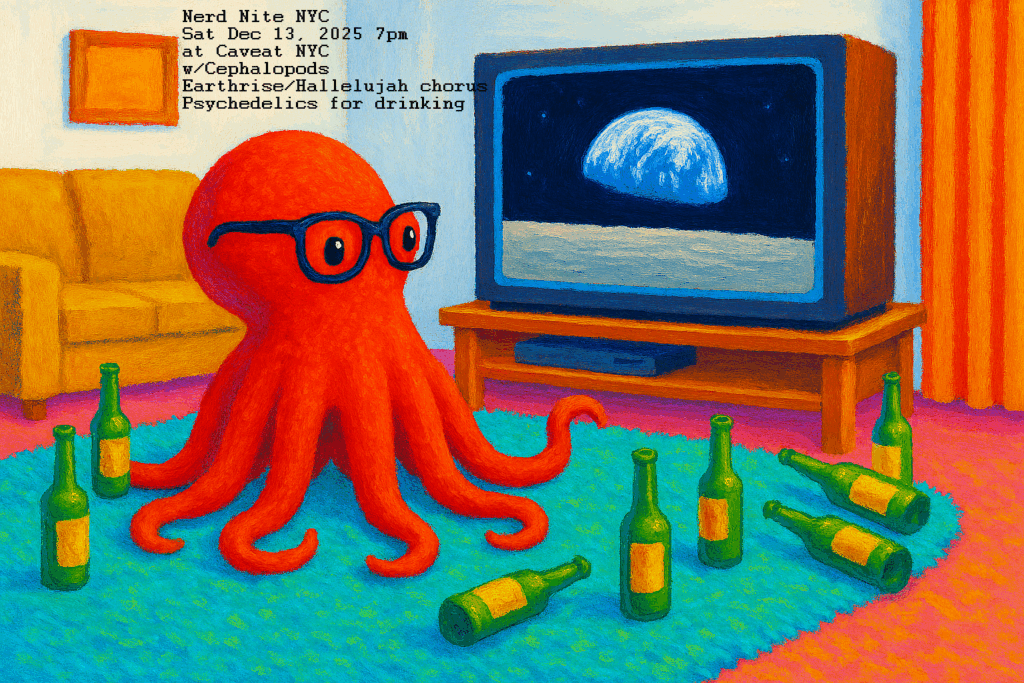
Hello! I’m taking part in another Nerd Nite event in NYC this weekend. Nerd Nite is a series of talks on interesting topics given by some of the smartest people I’ve ever met. I’ll obviously be the dumb one in this crowd. This time I’ll be talking about the corporatization of psychedelics and how we’re about to be Avatared into a brave new world of God pills and depression cures. I love Nerd Nite because it combines a number of my favorite things, including, but not limited to, drinking and nerds. This weekend it will take place at Caveat NYC and starts at 7 p.m. I encourage you to attend because it’s the last one of the year and it will be a blast. Looking forward to seeing you there! Nerd Nite NYC Sat Dec 13, 2025 at Caveat NYC with Octopuses, New Psychedelics, and the How the Hallelujah Chorus Relates to Earthrise – with Singing!Did Handel write the Messiah and its Hallelujah Chorus while tripping on ketamine and dressed as a giant squid? Let’s find out (well, kinda) at the December edition of Nerd Nite NYC which features fun-yet-informative presentations about squid and octopuses, weird new Silicon Valley-led hallucinogens, and the how the Hallelujah Chorus relates to the classic picture of the Earthrise – with actual singing! Tickets here. Back to the Lectures At-Hand: *Presentation #2 Description: It’s the year 2025. Mankind has fallen. Politics is polarized, humanity is on the brink of war and starvation. But, with the help of a few Silicon Valley startups, we might soon be able to take one pill to stop anxiety, simulate religious experiences, and trip through the cosmos without the pesky problem of drug legality and human testing. In short, we’re about to enter a brave new world of synthetic hallucinogens and it’s going to get weird. In this presentation, former TechCrunch and Gizmodo editor John Biggs will explore the weird world of experimental psychedelics including a company that makes legal cocaine and ayahuasca that can be dialed into your specific mood and personality. What we can definitely say about these new pills is that they’ll beat doing a handful of weird mushrooms in a van outside a Dave Matthews Band concert with a dirty man named Porkchop. *Presentation #3 Description: Earthrise, the magnificently humbling first photo of Mother Earth from space changed the world when first seen by humanity on December 24th, 1968. At this stage of human evolution we must bring this photo back into the public arena to help us move beyond tribalism and nationalism. Music will play an important part in this presentation! Bio: I’m a retired respiratory therapist and have been singing for peace and justice with the New York City Labor Chorus since 1991. You’re currently a free subscriber to Keep Going - A Guide to Unlocking Success. For the full experience, upgrade your subscription. If you’ve been reading or listening to Keep Going for free, you’ve already seen the value of having independent work that isn’t shaped by corporate sponsors or the news cycle’s noise. But independence has a cost. If you find something useful here, if these words make you pause or think, I’m asking you to step up. A few dollars each month means I can keep doing this work without compromise. Without your support, this project stays fragile, balanced on the backs of a few.
|





The Innovators: This Young CEO Wants to Make Genetic Engineering as Fun as Gardening
“When you're going through hell, keep going." This podcast is about failure and how it breeds success. Every week, we talk to remarkable people who have accomplished great things but have also faced failure along the way. By exploring their experiences, we can learn how to build, succeed, and stay humble. The podcast is hosted by author and former TechCrunch and New York Times journalist John Biggs.
He also hosts The Innovators, a podcast focused on brand new startups and C-Level Executives and Creators.
If you’d like to appear on either show, email john@biggs.cc.
Our theme music is by Policy, AKA Mark Buchwald. (https://freemusicarchive.org/music/policy/)
The Innovators: This Young CEO Wants to Make Genetic Engineering as Fun as Gardening
Most people meet plant cell culture in the grocery store without knowing it. You see it in the perfect row of blueberries, the identical bananas, the white orchids that look the same every single year. You do not see the lab bench and the flask behind them.
On The Innovators, I talked with Yoni Kalin, CEO of Plant Cell Technology, about the quiet infrastructure under all of that. His company has been working in plant tissue culture since 1993. What started as a small family business selling “pet plants” in jars has grown into a Utah based factory, a catalog of more than 500 products, and a bridge between plants, animal cells, fungi, and the people who work with them.
At the core, Plant Cell Technology makes the media and tools that keep cells alive and dividing. In the plant world that means the gel or liquid that feeds tiny cuttings, the nutrients that turn one node into a full clone. In the animal world that means the formulas that keep mammalian cells healthy in dishes and flasks. You can think of them as the food and basic kit that every lab needs before any vaccine or seedling can exist.
For the first thirty years they stayed in the plant lane. Last year they bought a manufacturing facility and stepped into mammalian cell culture. Now they blend media for human, animal, and insect cells as well. That move puts them inside the engine room of pharma and biotech, where the same cell lines are used for decades to test drugs and make biologic medicines.
Yoni gave a simple example. CHO cells, Chinese hamster ovary cells, have been in use since the middle of the last century. The original cells came from one animal. That line has been split and expanded for more than eighty years. Those cells are a standard test bed. If you want to grow a protein drug or check how something behaves, you feed those cells and watch. That kind of work used to mean a lot of live animal testing. The more you can do in culture, the less you have to do in a whole animal.
Plant cell culture is less visible but just as important. Instead of planting a seed and accepting whatever mix of traits comes back, growers take a cutting from a known plant, usually a meristem or small node, and regrow it in sterile media. The result is an exact clone of the parent. Every plant you make that way has the same genetics and the same performance.
If you are a berry grower, that consistency matters. It is the reason the box of blueberries you pick up in January tastes like the one you bought in July. If you are a greenhouse operator selling fancy houseplants, it means you can produce a thousand copies of the one pink variegated plant everyone wants instead of hoping more seeds turn out the same way. In orchards, forests, and replanting projects, it means you can fill a hillside with trees that all have the traits you need for that climate.
It is also the reason you can walk into a store like Trader Joe’s or Home Depot and see the same orchid color and shape every year. Orchid seeds are rough to work with. Cloning them in tissue culture lets growers keep exact copies of the best lines in circulation.
Plant Cell Technology sits in that supply chain as a “picks and shovels” vendor, to borrow Yoni’s phrase. They do not sell the fruit or the orchids. They sell the media, the bioreactors, the lab gear, and the training that lets growers and researchers do the work.
That education piece is important and it is where things get interesting outside the pure lab. Until a few years ago, if you wanted to learn plant tissue culture, you went to a university or a big corporate lab. You paid tuition or you got hired. Everyone else was on the outside.
Around 2020, while people were learning to bake sourdough and dance on short videos, Plant Cell Technology started posting long form instructional content. They now have hundreds of free videos that cover the basics, from aseptic technique to plant physiology to step by step protocols for setting up a small lab. On top of that they run in person and online master classes that focus on practical scale, not just textbook purity. Their goal is to teach you how to produce ten million banana plants, not just how to pass a midterm.
That effort has pulled in a new crowd, hobbyists and small entrepreneurs who want to clone rare plants at home. Anyone who has wandered into a trendy plant shop and seen a single cutting selling for forty or fifty dollars knows the appeal. With basic gear, a clean space, and the right media, you can take a small piece of that plant and grow hundreds of copies. That can feed a side business or just fill your home with green.
The same idea applies to fungi. Mycology is booming, and tissue culture is a good way to preserve and expand mycelium strains. It is easier in some ways, since many fungal media formulas are simple, often just agar and sugar. Yoni sees that as a gateway for people who might later move into more complex plant or mammalian work.
Behind the scenes, the company is pushing on automation. Tissue culture has been labor heavy for decades. A tech sits at a clean bench, cuts, transfers, seals jars, and repeats. That is slow and expensive.
Plant Cell Technology’s answer is a low cost bioreactor they call the BioCoupler, paired with an automated system called BioTilt. Instead of growing plantlets on gel in jars, they suspend plant cells or tiny explants in liquid and cycle them through soaking and draining. Soak, let them breathe, soak again. That simple rhythm gives the plant material full contact with nutrients, then air, which speeds up growth. Yoni says they see multiplication rates many times higher than on static gel media.
The cost drops too. Gel agents like agar and gellan gum are not cheap. A single kilogram can run close to a couple hundred dollars. A liquid system needs less of that. The BioTilt handles timing and immersion automatically. Sensors and software can watch the process, adjust schedules, and log data in a way a human tech with a clipboard cannot match.
The vision is clear. Larger labs and commercial houses will bring in robotics that can cut and move plant material. Bioreactors will handle the growth phase. AI systems will watch sensors, track contamination, and refine conditions. That kind of setup already exists at the very high end. Yoni wants to drag it into the middle of the market and make it less exotic.
When I asked him if this was the future of agriculture, he pushed back a bit. This is the present, he said. Seeds are not going away. Fields and barns are not going away. What he sees coming is a stack. At the bottom, a tissue culture lab where farmers keep their own genetics and do their own breeding. Above that, nursery space. Above that, growing and harvest.
Vertical farming has been a buzzword for a while. Tissue culture gives it teeth. You can stack genetics in a small lab that would need vast acreage outside. You can build local food systems that rely less on long chains of seed companies and middlemen. You can give farmers some control over the varieties they plant, instead of locking them into sterile seed contracts that keep them dependent.
Plant Cell Technology has moved a long way from a single “pet plant” in a jar. Under Yoni’s leadership, the company has turned into a small ecosystem, part manufacturer, part educator, part guide into a field that is usually hidden behind white coats and controlled access doors.
If you are a researcher who needs media, a grower who wants to scale, or a curious person who just wants to clone a favorite houseplant instead of buying three more, their site at plantcelltechnology.com is a place to start. The tools that shape our food and forests are no longer reserved for the biggest labs. They are slowly moving into reach, one flask at a time.
You’re currently a free subscriber to Keep Going - A Guide to Unlocking Success. For the full experience, upgrade your subscription.
If you’ve been reading or listening to Keep Going for free, you’ve already seen the value of having independent work that isn’t shaped by corporate sponsors or the news cycle’s noise. But independence has a cost. If you find something useful here, if these words make you pause or think, I’m asking you to step up. A few dollars each month means I can keep doing this work without compromise. Without your support, this project stays fragile, balanced on the backs of a few.
© 2025 John Biggs
548 Market Street PMB 72296, San Francisco, CA 94104
Unsubscribe