


Archive for February 02, 2025
Why tech went MAGA
“When you're going through hell, keep going." This podcast is about failure and how it breeds success. Every week, we talk to remarkable people who have accomplished great things but have also faced failure along the way. By exploring their experiences, we can learn how to build, succeed, and stay humble. The podcast is hosted by author and former TechCrunch and New York Times journalist John Biggs. He also hosts the Startup Show with Grit Daily, a podcast focused on brand new startups. If you’d like to appear on Keep Going, email john@biggs.cc. If you’d like to pitch on the Startup Show, please email Spencer Hulse (Spencer@gritdaily.com). Our theme music is by Policy, AKA Mark Buchwald. (https://freemusicarchive.org/music/policy/)
Remember the Dot-Com boom? Optimistic young technologists rolling in free cash built an internet in their Gen X image, focusing on logistics and media. The generation that saw gas lines and shuttered local businesses built ways for people in small towns to shop like big city folks. Further, the progenitors of zines decided that media was broken and had to be destroyed. They built the first blogs. Back in the mid-1990s, the nerdier among us (and I count myself in that cohort) were building the picks and shovels for a new Gold Rush, flying physical web servers around the world to bring companies online for the first time and selling simple web pages for hundreds of thousands of dollars. It was very lucrative. These same Gen Xers grew up wary of government and authority but also knew that they had to be on the right side of history to gain mass adoption. They were selling to the uninitiated, the noob. They had to be nice to everyone to grow their markets, from the suburban husband ordering a bulky stroller to the Brooklyn hipster having a Raspberry Pi delivered overnight. They saw markets everywhere, from Internet balloons over Africa to global auction and payment systems supporting the last days of the Beanie Baby craze. The goal was expansion at all costs, and the Democrats allowed them almost unfettered access to consumers, avoiding regulation unless it was in service to big business. This was the generation that brought us the DMCA to protect media corporations and the generation that threw millions of dollars at companies without business plans, only dreams. Gen X’s ultimate goal was to open up a big tent. Everyone was welcome. Everyone made money (except the Boomer investors who raced in to invest in dog after dog), and the Democratic Party saw the cash flowing. They cozied up to folks like Khosla, Ellison, and Bezos, and presumably, everyone was happy—the Clintons were in bed with SV way before anyone else. The UK even based its entire image—'Cool Britannia'—on mashups of Sony VAIO ads and the Spice Girls so they could take advantage of the growing technocratic intelligentsia. But was technology being built for technology’s sake? No one gave you a million dollars for writing a new device driver for Linux, nor did you get a Lambo for setting up Sotheby’s first auction site. Someone, somewhere got a Lambo eventually, but the benefits of being a technologist were limited to bragging rights and a nice salary in the late 1990s. If you grew up after the Dot-Com boom and before the AI boom, how did you make that Lambo money? Crypto. You weaponized your nerdiness. The unholy allianceFast forward to 2009. The mobile web was finally taking off, and the concept of digital gold—a concept rooted in Gen X anti-establishment tendencies—finally worked thanks to a hodgepodge of algorithms taken wholesale from other projects written by a developer and security author from Florida named Dave Kleiman. Kleiman has never been identified as the creator of Bitcoin, but many OGs—including co-coder Jeff Garzik—have created a trail that points to Kleiman.  What Kleiman did was make it clear that anyone could create a cryptocurrency. This meant that all you had to do to make some money was launch a coin—Doge, Ethereum, Polkadot—and sell it for pennies. Bitcoin’s rise, in turn, showed the post-dot-com generation that they could get rich quickly by paying lip service to decentralization while coding subpar projects. The vagaries of the current crypto market are unimportant. Instead, an entire cohort of bros emerged, believing they were owed the world—or at least 5 BTC. And because they were generating real money with their digital cash, they assumed they were geniuses. This shift transformed the average startup kid—someone dedicated to elegant technical solutions—into the crypto bro, someone more interested in buying a Rolex. This is not to say that startup folks were angels, but because the crypto bros were incentivized by millions in cash, they were far more dangerous. Neither Democrats nor Republicans knew quite what to do with this group and even actively fought against them, putting individuals in federal prison for making a few Bitcoin sales and occasionally calling for hits on competing drug lords. Further, regulators were slow to agree that unfettered capitalism was the answer, leading to a grassroots movement to accelerate humanity into a world of digital cash—controlled, inevitably, by guys who managed to make drinking on a boat look awful.
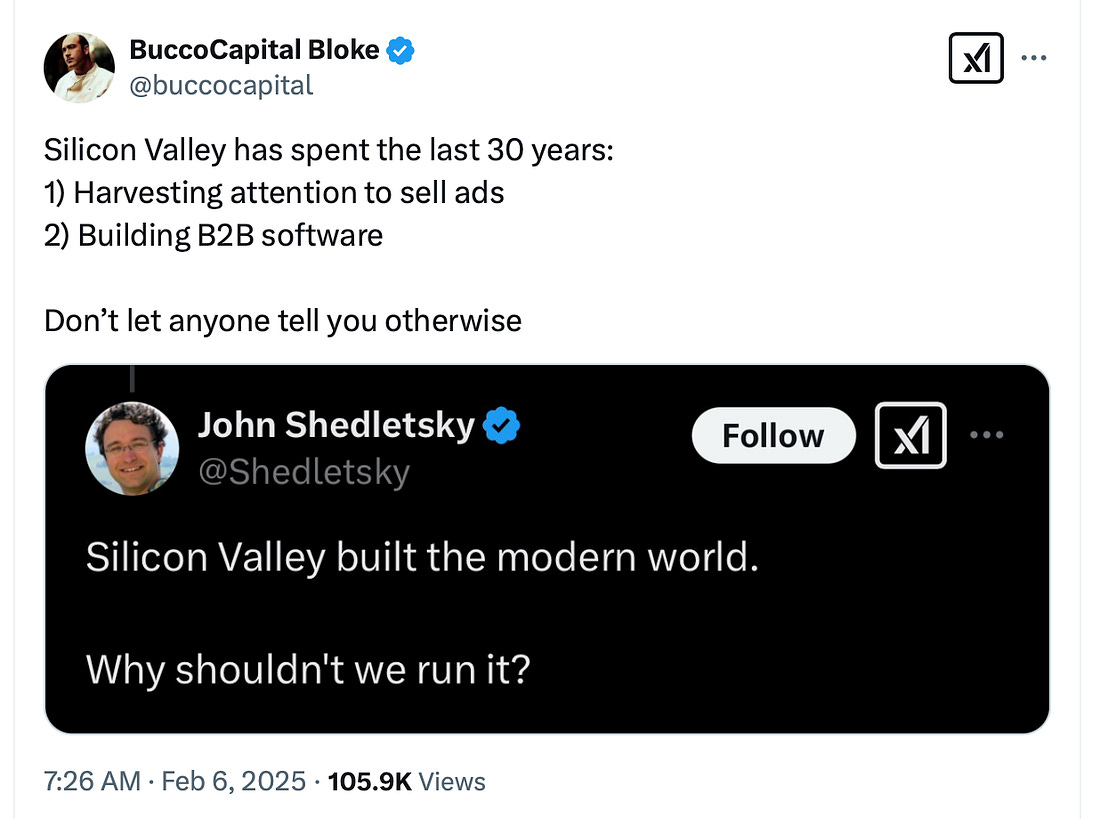
The rise of the weaponized nerd is only part of the equation. A guy like Elon Musk didn’t make his billions in crypto. He made his millions by convincing the gullible tech press to elevate him to god-like status. Tech reporting is about financeIn about 2008 the folks decimated by the Dot-Com crash came back thanks to rise of the mobile web. While there were a number of important technologies built in the intervening years, the primary goal of these Dot-Commers was to build tools to capture attention or B2B cash. The sites that did that best did so by following the Seven Deadly Sins Model - if it relates to pride, greed, wrath, envy, lust, gluttony, and sloth it made millions. Pride? Facebook and Instagram. Greed? Robinhood. Wrath? Reddit. Envy? Instagram again! Lust? Grindr and Tinder. Gluttony and Sloth? Uber Eats, baby!
At the same time, the crypto bros were rising in the ranks and were summarily ignored by everyone. Instead, the tech press learned to report on these new services in only one way: by assessing them financially. Most tech journalists don’t have a tech background, so they couldn’t tell if Clinkle or Theranos were doomed from the start, nor could they predict if a company would flame out in a year. Instead, they focused on the one thing they understood: big number is good. Every TechCrunch post was dedicated to sharing the idea that big number is good. Huge funding rounds made it to the front page, while the slow destruction of old institutions was cheered. Global taxi commissions were devastated. Hotels had to maintain sane pricing to compete with an app that let people rent out their homes to strangers. Amazon outsourced all the strategic thinking companies once had to do, creating a building block mentality—like Kleiman’s—that made launching a startup instantaneous. All of this led to the rise of Elon Musk, the biggest number in the big number is good clan. Instead of focusing on Musk’s eccentricities, the press fixated on his stock price. Instead of questioning the safety risks of his SpaceX rockets, they put him on stage. Kara Swisher, a journalist who should have known better, loved her access to Musk and turned it into her entire persona—until he stopped giving her scoops. In short, every tech article in the last twenty years was dedicated to numbers. Entrepreneurs saw those numbers go up and wanted in. They fought tooth and nail for their share of the VC pie and often failed. In the end, they became disillusioned, realizing they would never reach Elon Musk’s level in terms of big numbers. Interestingly, CEOs noticed this too. Mark Zuckerberg, for example, tried to listen to his advisors about fact-checking and DEI. He went through the motions—banning Trump after January 6 and appeasing the groups engaging in performative outrage (online, obviously). But eventually, Zuckerberg and others realized it didn’t matter. Zuckerberg even complained that despite all his DEI efforts, nobody praised him. Instead, the tech press kept writing about competitors with bigger numbers. He tried to do what was asked of him, and when he did, nobody cared. As the whole scene became unseemly, Democrats stopped engaging with Silicon Valley. So Silicon Valley decided to do something about it. They turned MAGA. The MAGA boysImagine a young person - usually a man - graduating college in the last few years. You spent your high school years trapped behind a screen taking online classes, and your ability to interact with real humans—online or in person—is limited. You might have made thousands of dollars shorting GameStop and realized that the financial world was smoke and mirrors. Further, you’ve always had unlimited access to the Internet because your parents or caregivers didn’t understand what you were doing. You had your headphones on, listening to the teacher with one ear and Andrew Tate with the other. If you grew up in a populous region—India or Africa, for example—you saw people you knew getting rich through gig work or scamming. If you grew up in Europe or America, you saw people getting rich by building sales funnels and online classes about gig work and scamming. Your closest relationships happened online; you shared your every pimple with folks on Snapchat and saw the world through a black rectangular prism held ten inches from your face until you fell asleep. Your view of the world is obviously skewed. Further, you feel aggrieved because you probably can’t find a girlfriend and see people sailing on yachts while you’re stuck in Paducah, Kentucky. Your college education is useful, but your networking skills are so poor that you can’t do much with your degree. You’re stuck, just like the rest of your cohort. So you lash out. Your life is dedicated to trolling. You want to win something, so you win at online arguments. You and your online friends meme-war people to the brink of suicide. You call for “ethics in gaming journalism” as a joke and eventually destroy journalism. You look at Peter Thiel, the proto-weaponized nerd, and think, “That’s the guy I want to work for.” And so you do. You work hard, run a few rug pulls, scam some cash. Then Elon Musk comes along and tells you to vote for someone you’d laugh at if you saw him fumbling with his pants in a public restroom—a 78-year-old slumlord who loves Yes Men but will always listen to anyone who makes more money than him. This is the guy you back. You come out to vote as a joke. Your hero pays for his presidency. He wins, meaning your hero wins. You’re unfettered, free. You can use the kind of language you use in chat rooms in real life. You get to go to balls and celebrations. People take you seriously, and your heroes become worldwide phenomena. Would you give that up? You wouldn’t. And you cheer when your hero accelerates the United States out of the Information Age into the AI age, bypassing the pooh-poohing and hand-wringing that accompanied previous watershed moments. The party that once preached conservatism is now the party of absolute wanton abandon. And because your guy is winning, you finally feel like you’re winning too. The road aheadThis never ends well. As I’ve written before, we are in the Crisis stage of the Four Turnings. Everything our grandparents built is being dismantled. The idea of the nation-state, national currency, and sovereignty is up for grabs. We are at a point where the great landmasses of America, Asia, and Europe are vying for control while simultaneously realizing that, given our current trajectory, we’ll all have to end up in space because it will be too hot and wet down here on Earth. Shit’s weird right now.
My view is simple: this is the last gasp of the Boomer generation, whose rage and confusion have been co-opted by their grandkids. Gam Gam and Pap Pap don’t want any Mexicans in the Wal-Mart, and their grandkids agree simply because it’s funny when they complain. They are given the sop of “strong borders” while the country’s monetary system is being destroyed from the inside. They are promised “cheap eggs” while the regulatory bodies ensuring those eggs don’t poison them are dismantled. The young want money, while the old want power. The current government offers all that and more. This won’t last long. I think Gen Z will have a lot to say in the next decade, and Gen Alpha will be completely feral—if not hilarious. The Gen X and Millennials who built the Internet in their image are fading, and their interest in self-weaponization will falter as they age. Instead, you’ll see a massive falling out between Musk and Trump, along with plenty of rioting from those who are done being trampled. It’s coming. Sadly, tech probably won’t be there to spur it along. AI is about to eat everyone’s lunch, and universal basic income and general unemployment will be the norm—though not in this decade. This is fine. It will teach humanity to live up to those old Silicon Valley Star Trek ideals—to live in harmony and such. Unless, of course, the crypto bros hijack the moon. Then we’re really sunk.
You're currently a free subscriber to Keep Going - A Guide to Unlocking Success. For the full experience, upgrade your subscription.
|









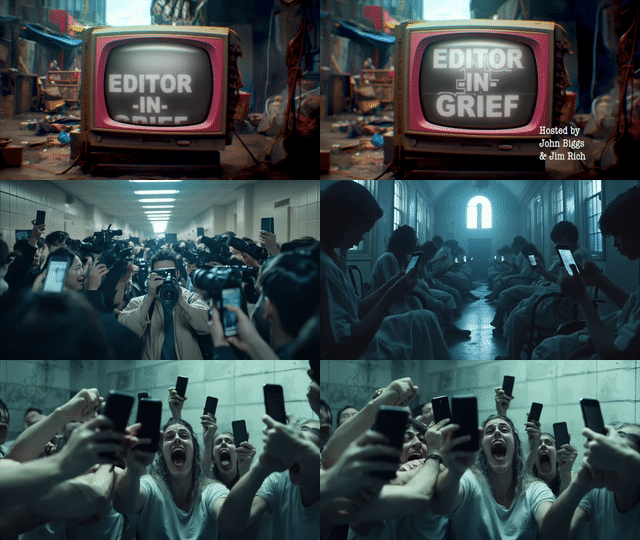
Editor-In-Grief: Why journalism sucks right now
“When you're going through hell, keep going." This podcast is about failure and how it breeds success. Every week, we talk to remarkable people who have accomplished great things but have also faced failure along the way. By exploring their experiences, we can learn how to build, succeed, and stay humble. The podcast is hosted by author and former TechCrunch and New York Times journalist John Biggs. He also hosts the Startup Show with Grit Daily, a podcast focused on brand new startups. If you’d like to appear on Keep Going, email john@biggs.cc. If you’d like to pitch on the Startup Show, please email Spencer Hulse (Spencer@gritdaily.com). Our theme music is by Policy, AKA Mark Buchwald. (https://freemusicarchive.org/music/policy/)
NOTE: This episode contains bad words. On the latest episode of Editor in Grief, Jim and I sat down with journalist and columnist Brian Karem to talk about the state of journalism today. Brian, a veteran reporter and host of Just Ask the Question, pulled no punches as we discussed what he calls "bend over and take it in the a** journalism." CrankWheel is a 10x simpler screen sharing solution, tailor-made for sales professionals. Add a screen sharing presentation to your sales call in 10 seconds flat. Your prospect clicks a link that you send by text message or email and immediately sees your presentation - no download or registration, even on their mobile device. Want to tap into newsletter audiences without the usual affiliate hassles? Submarket lets you pay newsletter owners only when their readers actually click your links. No upfront fees. No complicated codes. Just direct access to engaged newsletter audiences and crystal-clear analytics on every click. Test it out - create your first link in under 60 seconds. The Problem with Decorum JournalismJim kicked things off by defining what he calls "decorum journalism," where reporters avoid asking tough questions to maintain access, keep sources happy, or avoid backlash from fellow journalists. Brian took that further, arguing that the real problem is a mix of inexperience, access journalism, and corporate consolidation. The old model—where seasoned reporters asked tough questions and held power to account—is fading fast. Instead, we have newsrooms filled with younger, less experienced reporters who are hesitant to challenge authority. Brian pointed out that his mentors, Sam Donaldson and Helen Thomas, instilled in him the importance of asking questions—whether or not they get answered. “It doesn’t matter what the question is. It doesn’t matter if they answer it. It just matters that you ask it. That way you’ve put the issue on the record.” The White House Press Room: A Case Study in GroupthinkWe talked about how the White House press briefings have become performative. Brian recalled moments where reporters would speculate about what an official meant rather than just reporting what was actually said. That speculation would then turn into anonymous sourcing—one journalist repeating another's educated guess as insider information. He also shared stories about how institutional knowledge has vanished from the front row of the briefing room. Where there used to be decades of experience, there’s now a fraction of that, and it shows. “The problem in that briefing room is not just a lack of education, responsibility, and experience,” Brian said. “It’s the idea that you’ve never covered a beat before. You don’t know what the hell you’re doing.” The Real Cause: Corporate ConsolidationOne of the biggest threats to journalism, according to Brian, is the monopolization of media. Six companies control 95% of what Americans see, read, and hear. “We don’t have real journalism today. We have cheap entertainment.” He pointed out that newsrooms used to be filled with reporters who broke major stories, but corporate ownership and cost-cutting have gutted those institutions. Jim and I agreed. In our own experiences, we've seen vulture capitalists strip newsrooms for parts, cutting experienced reporters to save money while chasing profit margins that aren’t sustainable. The result? More clickbait, less investigative work, and a public that’s increasingly misinformed or disengaged. How Do We Fix This?Brian had a few ideas, and none of them involved waiting for billionaires to save us. He argued for breaking up media monopolies, providing tax incentives for local journalism, and supporting new models that prioritize actual reporting over entertainment. Local journalism, he stressed, is key. “There are 45% of the counties in this country that don’t have a single local news outlet. That means no one is covering city councils, school boards, or local government corruption.” Without local journalism, there’s no accountability, and without accountability, democracy suffers. The Bottom LineThis conversation reinforced what many of us in journalism already feel—our industry is in trouble, and it won’t fix itself. The corporate owners of media don’t care about informing the public; they care about turning a profit. And as long as we continue prioritizing access over accountability, entertainment over investigation, and groupthink over independence, the situation will only get worse. Brian’s book, Free the Press, digs deeper into these issues. If you care about the future of journalism, it’s worth a read. You're currently a free subscriber to Keep Going - A Guide to Unlocking Success. For the full experience, upgrade your subscription.
|

📷 Widya Winsu baru-baru ini memposting foto baru
Meta Platforms, Inc., Attention: Community Support, 1 Meta Way, Menlo Park, CA 94025