


Archive for October 26, 2025
After Container Ships Came for the Docks, Self-Driving Comes for the Roads
If you’ve been reading or listening to Keep Going for free, you’ve already seen the value of having independent work that isn’t shaped by corporate sponsors or the news cycle’s noise. But independence has a cost. If you find something useful here, if these words make you pause or think, I’m asking you to step up. A few dollars each month means I can keep doing this work without compromise. Without your support, this project stays fragile, balanced on the backs of a few. After Container Ships Came for the Docks, Self-Driving Comes for the RoadsA wave of automation is coming for truck drivers, not knowledge workers. The threat is not crashes. It is the quiet removal of millions of drivers from the economy.
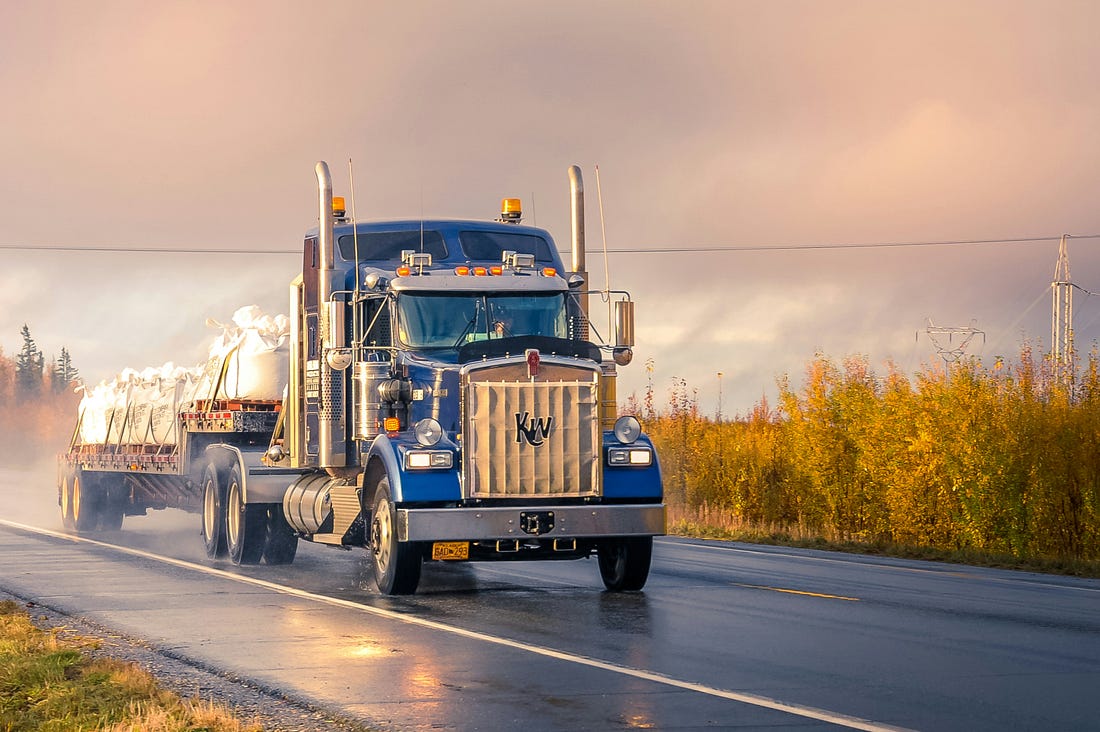
You’ve seen the videos: a Tesla driver is behind the wheel — filming for whatever reason — and the car starts to veer into the opposing lane or the computer bleeps and bloops into shutdown mode. Or there’s a Waymo smart car, unmanned, its LIDAR spinning, wandering around a parking lot or mistaking a motorcycle for a highway on-ramp. The videos are supposed to scare us. The robots are coming and they’re going to crash into us, right?  Wrong. They’re going to do something far worse. True self-driving vehicles are nearly impossible given current technology and level of investment. A friend who works on partially autonomous mining trucks, the kind that carry tons of ore and lumber out of distant jungles, talked about the six trillion dollar truck driver. “It’s going to cost someone six trillion dollars to replace human drivers completely. That includes the technology, the wireless connectivity, the processing power to let a truck drive itself from LA to New York without anyone behind the wheel,” he said. “Right now, they’re going to spend a fraction of that to keep humans in the loop. But what happens when that number goes down? What happens when six trillion becomes one trillion. Or a few billion?” As we enter a new dystopian age, we have to remember what we’re going to lose and where we have to assert our humanity. While we all have seen the headlines where erstwhile CEOs have been laying off middle managers and knowledge workers to replace them with useless AI agents, imagine the coming apocalypse as soon as someone with big enough pockets pays the bill for the $6 trillion dollar truck driver. The 3 Million Driver Time BombThe estimated total number of “Driver/Sales Workers and Truck Drivers” in the United States, according to the Bureau of Labor Statistics, is 3.51 million. This combines heavy and tractor-trailer drivers, light truck drivers, and driver-sales workers. In other words, it covers the long-haul truckers and the people dropping packages at your door. Pay sits in a narrow band. Heavy and tractor-trailer drivers earn a median of about $55,990 per year. Light truck drivers are near $46,090. Driver-sales workers are around $38,230. These are national medians, which means the numbers can be pulled down by the folks making very little while hauling your pet food and coffee filters. The American Trucking Associations estimate 8.4 million trucking-related jobs when you include dispatchers and warehouse workers. They say trucks moved about 72 percent of U.S. freight in 2024, which is not surprising given the state of the rail system. Globally, women drive roughly 7 percent of trucks by some estimates, so they remain a minority in this massive and vital industry. Add in global numbers and one thing is clear. There is a huge cohort of young and middle-aged men standing in the path of automation. What happens when millions of men lose their jobs at once? We have seen versions of this before. The Depression led to World War II which reshaped entire labor markets and communities by literally employing those men to kill each other. Then, more peaceably, came containerization. ... Continue reading this post for free in the Substack app
|






Innovators: Kimaru AI and the Case for Decision Intelligence
“When you're going through hell, keep going." This podcast is about failure and how it breeds success. Every week, we talk to remarkable people who have accomplished great things but have also faced failure along the way. By exploring their experiences, we can learn how to build, succeed, and stay humble. The podcast is hosted by author and former TechCrunch and New York Times journalist John Biggs. He also hosts The Innovators, a podcast focused on brand new startups and C-Level Executives and Creators. If you’d like to appear on either show, email john@biggs.cc. Our theme music is by Policy, AKA Mark Buchwald. (https://freemusicarchive.org/music/policy/)
We recorded late in Tokyo, and Evan Burkosky, CEO of Kimaru AI, laid out a claim that is both obvious and ignored. Most supply chains still run on spreadsheets. People glue together ERP exports, POS reports, CRM notes, and a flotilla of pivot tables, then hope the next week behaves like the last one. It rarely does. Kimaru calls its approach decision intelligence. Strip away the hype, and you get a layer that sits above the systems of record, learns from the metrics the business already tracks, and proposes concrete actions that a human reviews before anything happens. Instead of looking backward at what sold last quarter, planners see forward, with specific guidance on replenishment, pricing, safety stock, and routes, all framed by the constraints that actually govern their work. The company builds what they call a decision digital twin for each user and stakeholder. That twin encodes the choices a role can make, the outcomes that matter, and the limits that cannot be crossed. A set of software agents handles the tedious jobs that eat time, from connecting data and cleaning it, to reconciling mismatched fields across vendors and partners. Once that groundwork is in place, the system runs structured simulations and produces a single best recommendation. The user adjusts or approves, and the order flows back into the existing tools to open a purchase order or move a shipment. Nothing woolly, no free-running bot that buys five million widgets on a whim, and a clear circuit breaker that the user controls. The need is plain in any complex chain. An electronics maker in Taiwan hunts for copper, chips, and specialty parts, sells into high-end audio, and now faces tariffs, shifting routes, and new suppliers in places like Vietnam. A missed signal upstream turns into idle inventory and missed revenue downstream. Many teams still try to manage this with manual reports that take days to compile. Kimaru’s pitch is that the same work can take half a minute once the model understands the business and the user’s risk tolerance. Large firms often have parts of this effort underway. Data lakes in Snowflake or Databricks. Early agents that score demand or smooth seasonality. Kimaru’s value is the connective tissue. The architecture keeps raw data on site through federated learning, shares patterns without moving sensitive records, and records actions for compliance. It plugs into the stack that already exists and tries to make it useful, rather than selling an expensive rip and replace. Under the hood, the tools are not science fair novelties. They are the engines that have powered recommendations and prescriptive planning for a decade, from Monte Carlo to random forests to modern neural nets. The twist is in how those parts are arranged, how cross-company collaboration is modeled, and how the system learns from every correction a planner makes. Evan talked about chaos engines and fractal simulation from his CTO’s doctoral work, and even exploratory talks with quantum groups. The point is not to impress with jargon. The point is to give a planner a credible option on Tuesday morning that shortens a meeting and prevents a stockout. This is not a product for crane operators. It serves the inventory lead at a regional grocer, the VP who sets policy for a chain of factories, the manager who runs a distribution center and needs to pick a lane now. Kimaru has spoken with hundreds of people in those seats. All of them admit they live in spreadsheets because the official systems cannot keep up with the chaos outside the building. There is also the mood to consider. A wave of flashy pilots has soured many buyers on artificial intelligence. Reports claim that most generative pilots fail to produce value. Evan’s answer is blunt. Language toys are probabilistic by design, which makes them risky as a control surface. Operations need structure and memory. The decision layer gives the model something firm to run on, it narrows the error bars, and it keeps people in charge at the points that matter. Kimaru just finished Alchemist, closed out a pre-seed, and is opening a seed round. Interest is strong because the problem is large, boring, and very expensive. The global supply chain ties up vast sums in safety stock to hedge against shocks, and wastes more when plans lag reality. Every hour pulled out of manual reconciliation is an hour that can move product or cut costs. That is the theme worth noting. The most useful advances rarely sparkle. They remove friction that everyone has learned to tolerate. They give professionals a way to make the same decisions they make today, only faster, with clearer guardrails, and with less risk of groupthink. If Kimaru can turn the spreadsheet habit into a system that thinks ahead, it will not be glamorous. It will just be how the work gets done. You’re currently a free subscriber to Keep Going - A Guide to Unlocking Success. For the full experience, upgrade your subscription. If you’ve been reading or listening to Keep Going for free, you’ve already seen the value of having independent work that isn’t shaped by corporate sponsors or the news cycle’s noise. But independence has a cost. If you find something useful here, if these words make you pause or think, I’m asking you to step up. A few dollars each month means I can keep doing this work without compromise. Without your support, this project stays fragile, balanced on the backs of a few.
|



🔗 Neww Mann Jenewacity membagikan postingan D-ana M Sari
Meta Platforms, Inc., Attention: Community Support, 1 Meta Way, Menlo Park, CA 94025