


Archive for June 15, 2025
📸 Widya Winsu baru-baru ini memposting foto baru
| |||||||||||||||||||||||||||||||||||||||||||||||||||||||


📸 Oke Gorden baru-baru ini memposting foto baru
| |||||||||||||||||||||||||||||||||||||||||||||||||||||||

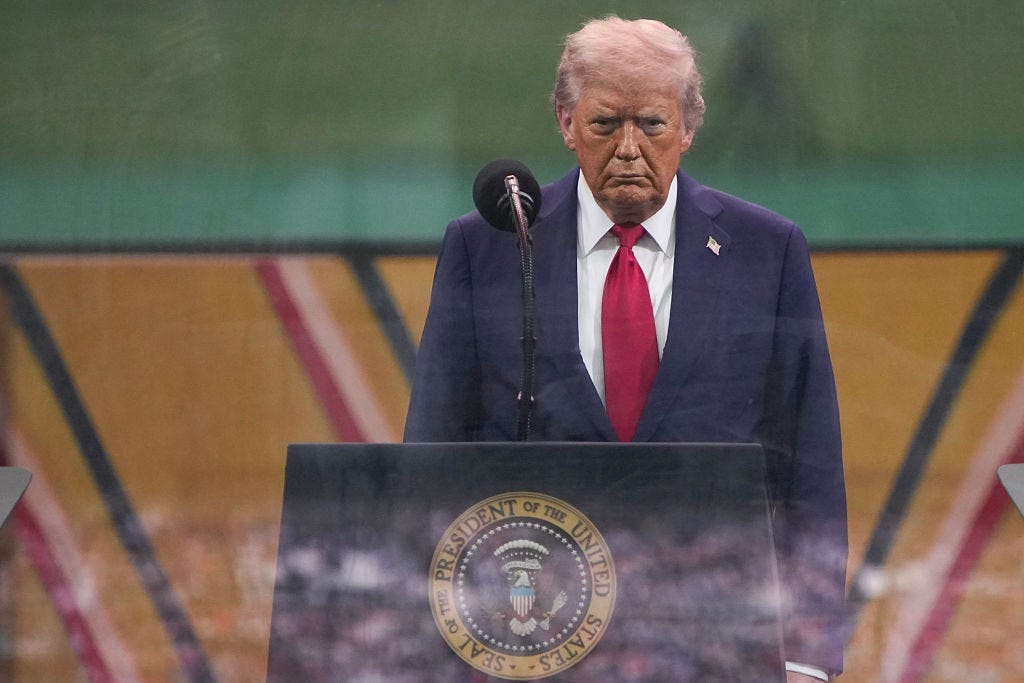
Trump's Flaccid Parade Is a Sign of Things to Come
Donald Trump finally got the military parade he had long wanted—an event initially inspired by the 2017 Bastille Day parade he saw in France. After being blocked during his first term, he returned to office surrounded by loyalists willing to carry out his demands. The parade, staged in Washington DC on his 79th birthday, was nominally meant to celebrate the U.S. Army’s 250th anniversary, but in reality, it served as a personal display of power and ego. The event featured tanks, jets, missiles, parachutists, and a “Happy Birthday” serenade, partly funded by taxpayers and corporate sponsors like Palantir and Coinbase. Despite the spectacle, the parade was underwhelming: soldiers marched off-beat, attendance was sparse, and the president looked bored. Rain and oppressive heat added to the lackluster mood. Meanwhile, mass protests unfolded across the country under the banner “No Kings,” presenting a stark contrast in energy and message. The parade itself was a year in the making. The plan was always to celebrate the 250th anniversary of the U.S. Army — a noble, if somewhat ham-handed, effort that was doomed to fail. The military doesn’t do culture, and parades are culture. They are supposed to be mesmerizing, exciting, and impressive and the modern military is all about force application, not jaunty playacting. As Anand Giridharadas wrote: “The country that invented jazz was never going to be good at putting on a military parade. It was never going to be us.” Critics see the parade not just as theater but as part of a larger authoritarian shift. Trump has taken control of military units, targeted dissenters, and deployed force against perceived enemies. The parade symbolized this transformation, but it also exposed how performative his authoritarianism is—more like a TV villain mimicking strongmen than a strategic leader. Still, the danger remains: even when he looks like he’s playacting, the consequences are real. Here’s the trick, though. Trump’s lackeys — the sycophants, the yes-men, the crypto bros — are hopeless at planning anything, let alone a government takeover. The movie Mountainhead (which is actually fine if you treat it as a very poorly paced dark comedy) expresses this delightfully by skewering the boy geniuses currently running amok in the Trump White House. From Elon Musk to J.D. Vance, everyone there thinks they know more than they do, and they’ve Dunning-Krugered themselves into gigs that are far above their mental capacities. Consider, for example, Trump Mobile. That’s right: there’s now a Donald Trump phone—a Temu-ass smartphone clad in “gold” with three cameras and a monthly $47.45 subscription fee. Everything about this phone points to a deep lack of respect for the customer, the kind of marketing move pulled by a bunch of “CEOs” on an Adderall binge, trying to steal as many users as possible before selling them back to a real carrier once the grift gets too expensive.
Finally, there’s Trump’s move to support Israel in its war against Iran. This promises to be more of nothing. While innocents die in both countries — not to mention those dying in Gaza — Trump will waste time pretending to get things done, big boy style. All this points to one thing: Trump is already a lame duck. He’s just waiting to get out. His crypto investments, his bluster, his sleeping on the job — all signs that he’s bored, frustrated, and tired of the charade. He knows he can’t actually become a dictator. And while I think his dictatorial potential is real if he were pulling this stuff in a country will even more grift and less democracy, I don’t believe America will let it happen. He and his team are just too stupid and the people who would vote for people like him will be dead soon enough. So protest. Fight. Talk to your friends and family so we don’t have to live through this bullshit again. But most of all, laugh. Trump hates that — and everything he’s doing is headed toward laughable failure.
|








Startup Show: Katie Kuo Is Watching Proteins Wiggle—And It Might Save Your Life
“When you're going through hell, keep going." This podcast is about failure and how it breeds success. Every week, we talk to remarkable people who have accomplished great things but have also faced failure along the way. By exploring their experiences, we can learn how to build, succeed, and stay humble. The podcast is hosted by author and former TechCrunch and New York Times journalist John Biggs.
He also hosts the Startup Show with Grit Daily, a podcast focused on brand new startups.
If you’d like to appear on Keep Going, email john@biggs.cc. If you’d like to pitch on the Startup Show, please email Spencer Hulse (Spencer@gritdaily.com).
Our theme music is by Policy, AKA Mark Buchwald. (https://freemusicarchive.org/music/policy/)
Startup Show: Katie Kuo Is Watching Proteins Wiggle—And It Might Save Your Life
Did you know proteins wiggle? I didn't.
On this episode of The Startup Show, I spoke with Katie Kuo, CEO and co-founder of Atomistic Insights, a biotech startup working to speed up drug discovery using physics-based machine learning. Born out of Georgia Tech and currently part of the Alchemist Accelerator, Atomistic Insights is trying to fix a known problem: new drugs take too long and cost too much. Think $2.6 billion and up to 15 years per FDA approval.
Katie’s background is in chemistry and drug discovery, and the company’s approach is refreshingly different. Instead of treating proteins like static objects, their system tracks how they actually move—atom by atom—in the body. That motion reveals hidden binding sites for drugs, which traditional drug design often misses. It’s like watching a lock move in slow motion until you see the exact shape of the keyhole.
Their method is already patented. The team has a working MVP. They’re raising their first round. And their goal is to go beyond software licensing to actually develop in-house therapeutics—taking their discoveries all the way to the clinic.
What makes Atomistic different isn’t just the tech. It’s the founder mindset. Katie isn’t chasing AI hype. She came from a lab, saw how slow and expensive drug discovery is, and wanted to do something about it. This is a startup driven by application, not abstraction.
So, what’s next? More partnerships, deeper simulations, and eventually, real drugs designed faster and cheaper using Katie’s system. Atomistic isn’t trying to replace drug discovery. They’re just trying to make it suck less.
You can learn more at atomisticinsights.com (or at least try to spell it correctly in your search bar).
You're currently a free subscriber to Keep Going - A Guide to Unlocking Success. For the full experience, upgrade your subscription.
Upgrade to paid
© 2025 John Biggs
548 Market Street PMB 72296, San Francisco, CA 94104
Unsubscribe