


With America in Shambles, Europe Must Become Less Risk Averse
“When you're going through hell, keep going." This podcast is about failure and how it breeds success. Every week, we talk to remarkable people who have accomplished great things but have also faced failure along the way. By exploring their experiences, we can learn how to build, succeed, and stay humble. The podcast is hosted by author and former TechCrunch and New York Times journalist John Biggs. He also hosts the Startup Show with Grit Daily, a podcast focused on brand new startups. If you’d like to appear on Keep Going, email john@biggs.cc. If you’d like to pitch on the Startup Show, please email Spencer Hulse (Spencer@gritdaily.com). Our theme music is by Policy, AKA Mark Buchwald. (https://freemusicarchive.org/music/policy/)
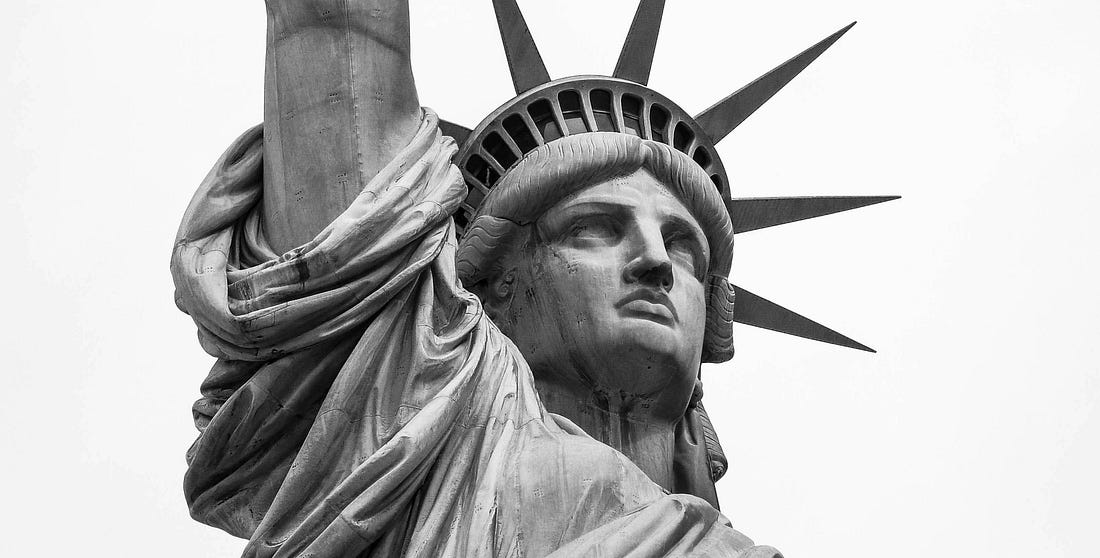
This is excerpt from a post over a Resilience Media where I’m helping out with editorial. It discusses what Europe needs to do now that the U.S. is down for the count. "Never interrupt your enemy when he is making a mistake." Thanks for reading! Subscribe for free to receive new posts and support my work. Napoleon once offered that old chestnut to strategists who were too focused on victory to notice failure. But what if we aren’t talking about an enemy, but a temporarily addled ally? All signs point to four years of chaos from the White House while existential threats—military, economic, and societal—mass on Europe’s borders. With all eyes on Wall Street, what must Europe do to protect Marszałkowska, the Champs-Élysées, and Unter den Linden? Europe, in short, will have to stop waiting and start acting. Failed StatesAmerica under Trump is a failed state—focused inward and committed by holy decree to nationalism and isolationism. The polarization seen across the country today, marked by ongoing protests in every state and major city, and today’s violent economic volatility, won’t end until at least the midterms—when the “silent majority” of Trumpist boomers and Gen Xers may finally go quiet for another decade. Further, Trump’s tariffs and anti-globalist stance—while good for Fox News headlines—are straining the compacts the U.S. once maintained with the rest of the world. Foreign policy usually swings between administrations, but rarely has it gone to such extremes as it has under Trump 2. Like Orbán, Johnson, and Kaczyński before him, Trump is a nationalist leader whose ideas appeal to an uneducated minority. This leads to a weak commitment to NATO and transatlantic cooperation—and it will push the intelligent, or at least the business-savvy, to ignore the globe and focus inward. ParalysisEurope has spent decades shaping its policies around the assumption that the United States would always provide a stabilizing anchor. In security, energy, and technology, Washington has acted as both shield and engine. NATO, long funded and driven by the U.S., has allowed many European states to underinvest in their own defense. U.S. tech firms dominate Europe’s digital infrastructure. Even energy decisions—like the slow pivot away from Russian gas—often lagged behind American pressure rather than growing out of unified European planning. Obviously, this is an exaggeration for effect. But what’s clear is that Europe has adopted a posture that’s fundamentally reactive. European leaders rarely make big moves unless Washington moves first. Even when U.S. choices are flawed or incoherent, there’s still reluctance to step out alone. Strategic autonomy is discussed but rarely pursued. The war in Ukraine should have triggered a permanent rethinking of defense and energy policy. Instead, there’s been a cautious—but increasingly frenzied—scramble to respond. Part of the hesitation comes from internal structure. The EU isn’t built for fast or bold moves. Decision-making often stalls in endless rounds of consensus-building. Member states worry more about offending each other than projecting power abroad. In this environment, risk aversion isn’t just habit—it’s built into the machinery. But in a world that’s speeding up and shifting quickly, that machinery needs to change. Fear of internal division is real, and very potent, when it comes to pan-European politics. At a time when every country must stand together, the old Euro habit of staying quiet until someone else pipes up is no longer enough. You're currently a free subscriber to Keep Going - A Guide to Unlocking Success. For the full experience, upgrade your subscription.
|




Why Trump Is Killing the Dollar
“When you're going through hell, keep going." This podcast is about failure and how it breeds success. Every week, we talk to remarkable people who have accomplished great things but have also faced failure along the way. By exploring their experiences, we can learn how to build, succeed, and stay humble. The podcast is hosted by author and former TechCrunch and New York Times journalist John Biggs. He also hosts the Startup Show with Grit Daily, a podcast focused on brand new startups. If you’d like to appear on Keep Going, email john@biggs.cc. If you’d like to pitch on the Startup Show, please email Spencer Hulse (Spencer@gritdaily.com). Our theme music is by Policy, AKA Mark Buchwald. (https://freemusicarchive.org/music/policy/) I take no joy in pointing out the obvious: Trump and his technocrats are setting up the U.S. economy to fail, possibly leading to a recession—if not a full-blown depression. Trump, ever the egotist, doesn’t see it coming. Like the mafia friends who helped him bankrupt his casinos, he’s being used by smarter people to carry out something far more calculated. Here’s the first reason they’re working so hard to seem insane: Thiel and Musk want the world’s reserve currency to be some form of cryptocurrency. Maybe it’s bitcoin. Maybe it’s a so-called sovereign currency issued by each government and instantly interchangeable across borders. Either way, the goal is to bypass the traditional system—no central banks, no SEC, no oversight. Money moves freely, without checks or balances. The easiest way to tank the dollar is through tariffs. Tariffs of this magnitude and with this theatrically are aimed at one thing: destabilizing our economy. Trump sees tariffs as a simple deal. He thinks that because France taxes U.S. imports, the U.S. should return the favor. In January 2025, France exported $51.2 billion to the U.S., while the U.S. exported $42.9 billion to France. That imbalance looks excessive at first glance, but much of what we import from France is high-value industrial equipment—gas turbines used in aviation, for example. Both countries trade expensive goods. France might sell us more wine than we sell them, and sure, their cheese is better. But is that trade deficit worth escalating into economic warfare? Absolutely not. And it won’t take long before middle America realizes the Temu junk they’ve been buying now costs 100 times more, with no American-made alternative in sight. These tariffs are a distraction—a way to keep Trump and his base occupied while the real plan unfolds behind the scenes. This isn’t overt conspiracy. It’s a long game. The goal is clear: the Silicon Valley right wants crypto to replace the dollar. Once the U.S. dollar becomes too volatile for international trade—when it can no longer be used reliably to buy gas turbines or petroleum—other countries will move to digital systems like Bitcoin, ChinaCoin, or KazakhCoin. These trades will be seamless. Running them will create massive arbitrage opportunities. They want to tear down the monetary system built over the last century and give each country—if that concept still exists—its own fluid, algorithmically managed currency. That shift opens every balance sheet to the world, replaces central banking with code, and makes taxation a mess. There’s another reason Trump may want the economy to crash: interest rates. Roughly $9.2 trillion in U.S. government debt will mature or need refinancing in 2025. That debt—mostly in bonds—needs to be rolled over. The only way to reduce borrowing costs before then is to push interest rates down. And historically, rate cuts follow recessions. Every U.S. recession since the 1980s has come after a peak in the federal funds rate. The Fed cuts rates to slow the bleeding. In the past two months, the 10-year Treasury yield has dropped about 60 basis points. That drop reflects rising recession fears. Many economists say the market is still in denial and should already be down 40 to 60 percent. Oil prices are down too—six-month lows. Trump has pushed for lower oil and lower rates, which raises the question: is this all just about lowering inflation and cutting borrowing costs, even if it means tanking the economy? Meanwhile, inflation expectations among consumers keep rising—now projected around 6 percent. That usually leads to higher rates. But the bond market is still pricing in a recession. The Atlanta Fed’s GDP forecast just collapsed from plus 3.9 percent to minus 2.8 percent in four weeks. That’s not a soft landing. That’s a stall. The U.S. is carrying $36.2 trillion in debt, with an average interest rate of 3.2 percent—the highest since 2010. $9.2 trillion of that comes due in 2025. Seventy percent of it will hit between January and June. If rates stay where they are, refinancing costs will explode. The budget can’t handle that kind of spike. In 2024, the U.S. spent $7.8 trillion but only brought in $5 trillion. That’s $1.56 spent for every dollar earned. Without lower rates, the math doesn’t work. A recession all but guarantees those rate cuts. Whether intentional or not, that seems to be the direction. The one thing Trump can’t change by decree? Interest rates. So he’ll do what the business elite tells him to do—even if it costs him support. Trump is a lame-duck president leading a lame-duck party. Once this all plays out, Republicans will be deeply distrusted for the next decade or more. Many of their hard-won prohibitions will be swept away by AOC-style lawmakers who will do what Democrats failed to do during the Biden years: enshrine human rights into the Constitution. That could take the form of abortion protections, equal rights for all, free healthcare, and possibly tuition-free education. But we’ll have to get through a lot of chaos before we get there—and most likely, some of that chaos will leave a mark. You're currently a free subscriber to Keep Going - A Guide to Unlocking Success. For the full experience, upgrade your subscription.
|


Keep Going: Dopamine Detox and Why You Can’t Sit Still
“When you're going through hell, keep going." This podcast is about failure and how it breeds success. Every week, we talk to remarkable people who have accomplished great things but have also faced failure along the way. By exploring their experiences, we can learn how to build, succeed, and stay humble. The podcast is hosted by author and former TechCrunch and New York Times journalist John Biggs.
He also hosts the Startup Show with Grit Daily, a podcast focused on brand new startups.
If you’d like to appear on Keep Going, email john@biggs.cc. If you’d like to pitch on the Startup Show, please email Spencer Hulse (Spencer@gritdaily.com).
Our theme music is by Policy, AKA Mark Buchwald. (https://freemusicarchive.org/music/policy/)
Keep Going: Dopamine Detox and Why You Can’t Sit Still
Everyone needs to turn off their phones.
This week on Keep Going, I sat down with Judy Kadylak. She’s a leadership coach who works in psychedelic integration. That sounds like two different jobs, but she’s found something interesting in the overlap: people trying to lead others without knowing how to sit still with themselves.
Judy’s focus lately has been on dopamine. Not the abstract brain science stuff, but the actual patterns we fall into when we’re hooked on cheap rewards—scrolling, snacking, constant stimulation. She started noticing it in her clients. Then in herself. Social media was rewiring her days. So she tried a detox. Not the biohacking kind. Just a hard pause on the hits: no phone in the morning, fewer distractions during the day.
It worked. It changed how she felt about work, motivation, and focus. She started building it into her coaching—especially for clients who wanted to use psychedelics as part of their growth. She found that without cutting down the dopamine noise, even a solid psychedelic session could feel flat. The insights didn’t land. The breakthroughs didn’t stick.
Now she’s running a group program around the detox idea. It’s a month long. It starts simple—don’t touch your phone for the first hour of the day. She says that alone can change how your brain handles reward for the rest of the day. Most of her clients don’t come in meditating or reflecting. But a week or two in, they start to.
Judy's not militant about it. She doesn’t tell people to quit social media. She helps them figure out their triggers and build space between the trigger and the habit. The point isn’t to eliminate pleasure. It’s to reset how we relate to it.
If you’re interested in her program, check out judykadylak.com.
I’m still not sure I’m ready to give up my morning scroll. But Judy makes a strong case for at least trying. We can’t talk about leadership or growth if we’re afraid to sit still. And maybe we’re not failing—we’re just running low on quiet.
Invite your friends and earn rewards
Invite Friends
© 2025 John Biggs
548 Market Street PMB 72296, San Francisco, CA 94104
Unsubscribe