


Archive for April 05, 2026
Generated Weekly: What is good AI art?

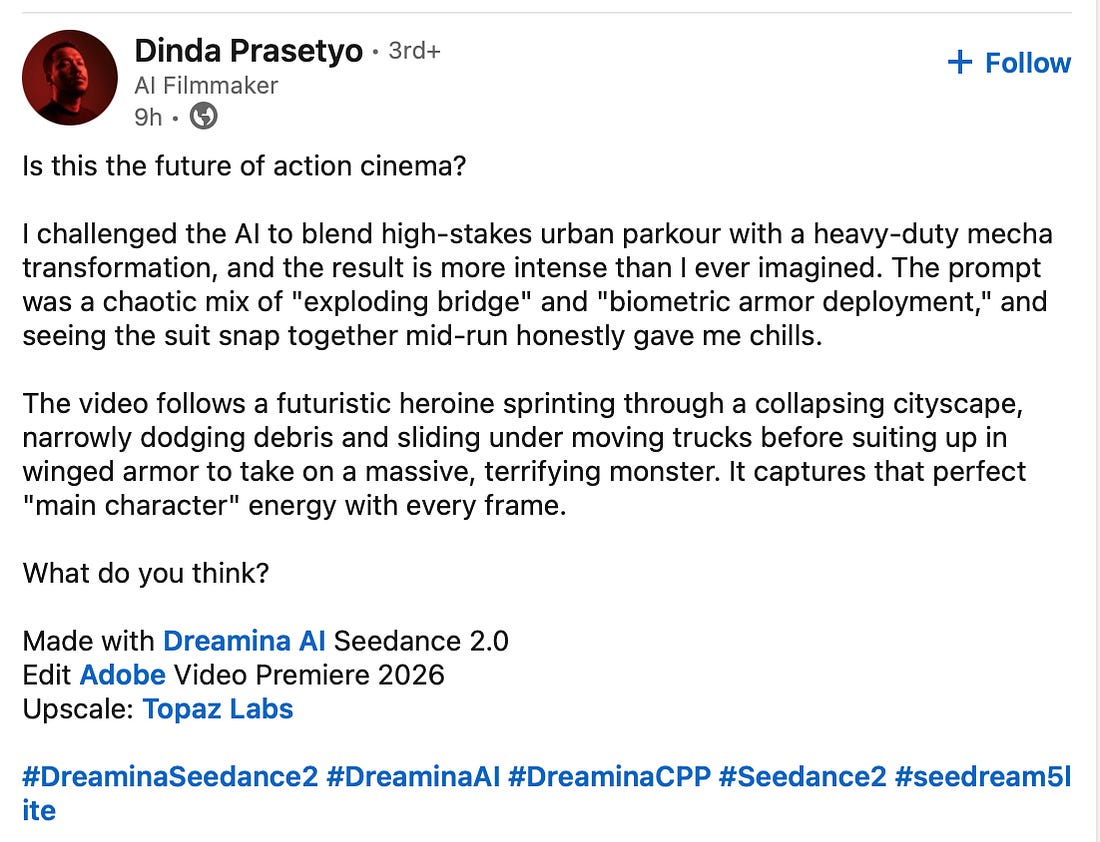
There’s a battle raging online between digital creators. Some creators, usually those with a track record of shooting traditional video, see the work of AI video artists who share something visually stunning but without soul. For example, take this by “AI filmmaker” Dinda Prasetyo: 
Are you building an AI product? Work for a brand looking for AI video experts? We’re holding the first AI marketing video awards in New York this May! We’ll be posting more information this month but until then visit the website and sign up if you’d like to join as a brand sponsor.
Now we can assume that Prasetyo is producing content in earnest and hoping to express themselves as a creator. They’re not paying lip service to the idea of “filmmaker” even though their product is essentially a clip that could have come from a video game. Then comes the criticism. The responses range from “You’re out of a job, Spielberg” to “This is junk.” Some choice comments:
Neither viewpoint is wrong. The classicists are looking for what Robert Pirsig would have called “quality,” whereas the technologists see the tools and their evolution. Both viewpoints are vital to the growth of this industry. To an artist, a paintbrush is made to capture reality on canvas. To a toolmaker, the paintbrush is great at slathering matte latex onto a wall. But when they both stand in front of a Monet or Pollock, they’re both in awe. The critics are not just angry. They are pointing at something real. When everything is possible, nothing matters unless you choose to make it matter. A collapsing bridge means less when no one had to build it, light it, or stand on it. A stunt means less when no one risked a fall. There is a human memory tied to effort. But the defenders are not wrong either. Every tool has looked crude at the start. Early digital video looked flat. Early CGI looked fake. Then it got better. Then it became normal. What is missing right now is not skill. The systems can already generate spectacle. What is missing is restraint. The sense that a creator chose this moment and not the thousand others the machine could produce. The sense that behind the image there is a mind that cares about what comes before and after. Right now, most AI video feels like a highlight reel with no game attached. A series of peaks with no climb. You see everything at once, and so you feel very little. The older creators are asking for story, for character, for stakes. The newer creators are asking for freedom, for speed, for reach. Both are right, and both are incomplete. Because the truth is simpler and harder. Tools do not create meaning. People do. A camera never made a film. A prompt will not either. The next phase will not be about better explosions or smoother motion. It will be about someone using these tools and deciding to hold back. To build a scene that takes time. To make a viewer wait. To risk being boring for a moment so that something else can land later. In other words, the next phase will be the art, not the science, of generated video. Alibaba just revealed it’s behind a viral AI video model dominating leaderboardsAlibaba has revealed that it is behind “HappyHorse,” a previously mysterious AI video generation model that has been quietly topping industry benchmarks, according to a CNBC report. The model gained attention after appearing on global leaderboards without a clear origin, outperforming or matching leading systems in areas like motion quality and consistency. Its strong results put it in direct competition with tools from OpenAI and Google, including their video models Sora and Veo. Alibaba’s confirmation ends speculation about who built the system and signals a more aggressive push into generative AI, especially video, which is emerging as the next major battleground after text and images. AI-generated Lego videos and Trump’s poo-bombing: welcome to the Iran-US slopaganda wars
AI-generated videos are starting to reshape how political messages spread online, blending humor, animation, and current events into fast-moving, highly shareable clips. Iran, for example, has been dumping out LEGO animations featuring pointing critiques of the Trump administration, a clever and fascinating way to spread propaganda through vitality. Seedance 2.0: The Most Controversial AI Video Model in the World Just Landed in the USCapCut has rolled out a new “Video Studio” that integrates Dreamina Seedance 2.0, a fast-rising AI video model, directly into a canvas-based editing environment. Instead of a traditional timeline, the new tool lets users create videos from start to finish in one space, handling everything from idea generation and storyboarding to scene creation and final edits. The goal is to simplify the process so creators can turn prompts, images, or rough ideas into finished videos with minimal manual work. Seedance 2.0 itself is a text-to-video model that has gained attention for producing more realistic motion, stronger visual consistency, and better control over scenes compared to earlier tools.
|









If a job asks you to paste a terminal command, walk away
“When you're going through hell, keep going." This podcast is about failure and how it breeds success. Every week, we talk to remarkable people who have accomplished great things but have also faced failure along the way. By exploring their experiences, we can learn how to build, succeed, and stay humble. The podcast is hosted by author and former TechCrunch and New York Times journalist John Biggs.
He also hosts The Innovators, a podcast focused on brand new startups and C-Level Executives and Creators.
If you’d like to appear on either show, email john@biggs.cc.
Our theme music is by Policy, AKA Mark Buchwald. (https://freemusicarchive.org/music/policy/)
If a job asks you to paste a terminal command, walk away
I ran into a strange hack this week. It looks simple at first, but it is not. It targets job seekers. I think I recall submitting a resume for a job at a company called Runeapes, which, at least on the surface, looks like a real website.
You get a message saying you missed an appointment. It points you to a booking page. The name looks normal, the flow looks normal. You click through, pick a time, go through the usual steps. Nothing stands out.
Then it asks you to get ready for the meeting.
There is a download for Windows, which is expected. Then there is a “download” for macOS. That is where things change. Instead of a file, you get a terminal command. A curl command. It tells you to paste it into your terminal. If you’re not technical, this step can inject so much malware into your system that you’ll probably be hacked for life.
That should stop you right there.
The command points to a domain that looks real at a glance but is not. The domain was created recently. Same with the app domain tied to the booking flow. Both showed up within the past month or so.
I started poking around. The site has all the usual pages: Pricing, About, Blog, Careers, Contact. Every single one is dead. Links go nowhere. Social links are junk. It is a full layout with no substance behind it.
I tried to pull the file without running it, just to see what it was doing. Even that failed. The endpoint is already gone. Whatever was there has been taken down or moved.
So what is the point?
The point is to get you to run a command you do not understand. If you paste that into your terminal and hit enter, you are giving it permission to do whatever it wants on your machine. Download code, run it, install something, pull data, anything.
Most people are not used to seeing terminal commands in a normal workflow, but the setup here is convincing enough that someone might go along with it. It looks like a meeting tool. It feels like onboarding. You are already halfway committed by the time you see the command.
That is the trick.
If you take one thing from this, it is simple: Do not paste random commands into your terminal. Ever. It does not matter how official the site looks or how normal the flow feels. If you do not know exactly what a command does, do not run it.
Also, we know that hackers are targeting the desperate. There are endless crypto scams out there, and this one targets job seekers who are already probably exhausted. Please be careful any time someone asks you to use anything outside of Zoom, Calendly, or Google Meet. Also, make sure you never, ever download weird apps to connect to any kind of video meeting.
This one is already dead, but there will be more.
You’re currently a free subscriber to Keep Going - A Guide to Unlocking Success. For the full experience, upgrade your subscription.
If you’ve been reading or listening to Keep Going for free, you’ve already seen the value of having independent work that isn’t shaped by corporate sponsors or the news cycle’s noise. But independence has a cost. If you find something useful here, if these words make you pause or think, I’m asking you to step up. A few dollars each month means I can keep doing this work without compromise. Without your support, this project stays fragile, balanced on the backs of a few.
© 2026 John Biggs
548 Market Street PMB 72296, San Francisco, CA 94104
Unsubscribe